What is HTML? The Ultimate Guide from Its Origins to Modern Web Standards
If you are a web developer, HTML (HyperText Markup Language) is the very first thing you learn. It is the absolute skeleton of every website on the internet. Whether you are building a simple portfolio or a complex web app using Next.js or React, underneath it all, the browser is still reading HTML.
To truly master web development, you need to understand what HTML is, where it came from, and how it is used in modern development today. Let’s take a deep dive.
The Origin: How It All Started
HTML was invented by Sir Tim Berners-Lee in 1989. Working at CERN (the European Organization for Nuclear Research), his goal wasn't to create global social media or e-commerce sites. He simply wanted a way for scientists across different universities to easily share and link research documents together over the internet.
That simple idea of "Hyperlinks" (clicking a text to go to another page) changed the world forever.
The Evolution Timeline
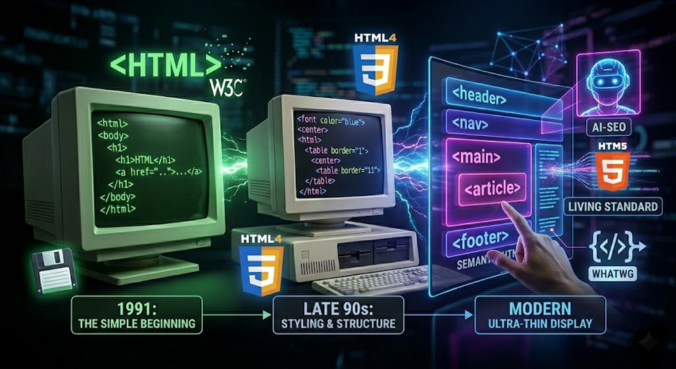
HTML has gone through several massive upgrades over the last three decades to keep up with how we use the internet.
- The Early Days (HTML 1.0 & 2.0 - Early 90s): The very first versions were extremely basic. There was no CSS and no JavaScript. Pages were purely text-based with simple headings, paragraphs, lists, and the revolutionary <a> tag for links.
- The Styling Era (HTML 3.2 & 4.01 - Late 90s): As the internet became popular, developers used HTML tags to style pages (like the infamous <font> tag) and complex HTML Tables to create website layouts. HTML 4.01 started standardizing this by separating styling (CSS) from the structure.
- The Strict Era (XHTML - 2000s): The web standards committee tried to make HTML much stricter. If you forgot to close a single tag (like <br> instead of <br />), your entire website might break. It forced cleaner code but was incredibly frustrating.
- The Modern Revolution (HTML5 - 2014): This was the ultimate game-changer. HTML5 revolutionized the web by introducing native multimedia (<audio> and <video>), advanced APIs (<canvas>), and semantic elements.
What is HTML Today? (The Modern Landscape)
If you are coding today, you aren't just writing the old HTML5; you are writing what is now called the "HTML Living Standard". It is constantly updated to meet the demands of modern browsers.
Here is how professional developers use HTML today:
1. Semantic HTML is Mandatory: In the past, developers used <div> tags for everything. Today, that is considered bad practice. We now use Semantic Tags like <header>, <main>, <article>, and <nav>. Why? Because Search Engines (Google) and AI-driven bots read these tags to understand the context of your page. Good semantics equal good SEO.
2. Accessibility (a11y) is a Priority: Modern HTML isn't just for screens; it's for everyone. Developers now heavily use ARIA (Accessible Rich Internet Applications) attributes within their HTML to ensure visually impaired users can navigate websites using screen readers.
3. The Backbone of Frameworks: Even if you are writing React, Vue, or using AI tools like Cursor to generate code, your final output is still HTML. Modern JavaScript simply manipulates the HTML structure (the DOM) dynamically. You cannot be a great React developer without being a master of HTML first.
4. Native Web Components: Today, HTML allows developers to create their own custom, reusable tags (like <my-custom-button>) using Web Components, reducing the reliance on heavy JavaScript libraries for simple UI elements.
The Verdict
HTML might be easy to learn, but it takes time to master. It has evolved from a simple tool for sharing scientific papers into a robust, dynamic markup language that powers the entire digital world. Start focusing on writing clean, semantic HTML today, and your future code (and users) will thank you.
— Epun Manula (EDM Producer · Designer · Developer)
Tags
#html#web history#html5#tim berners-lee#web development basics